Artificial Turf and Pavers in a Scottsdale Yard
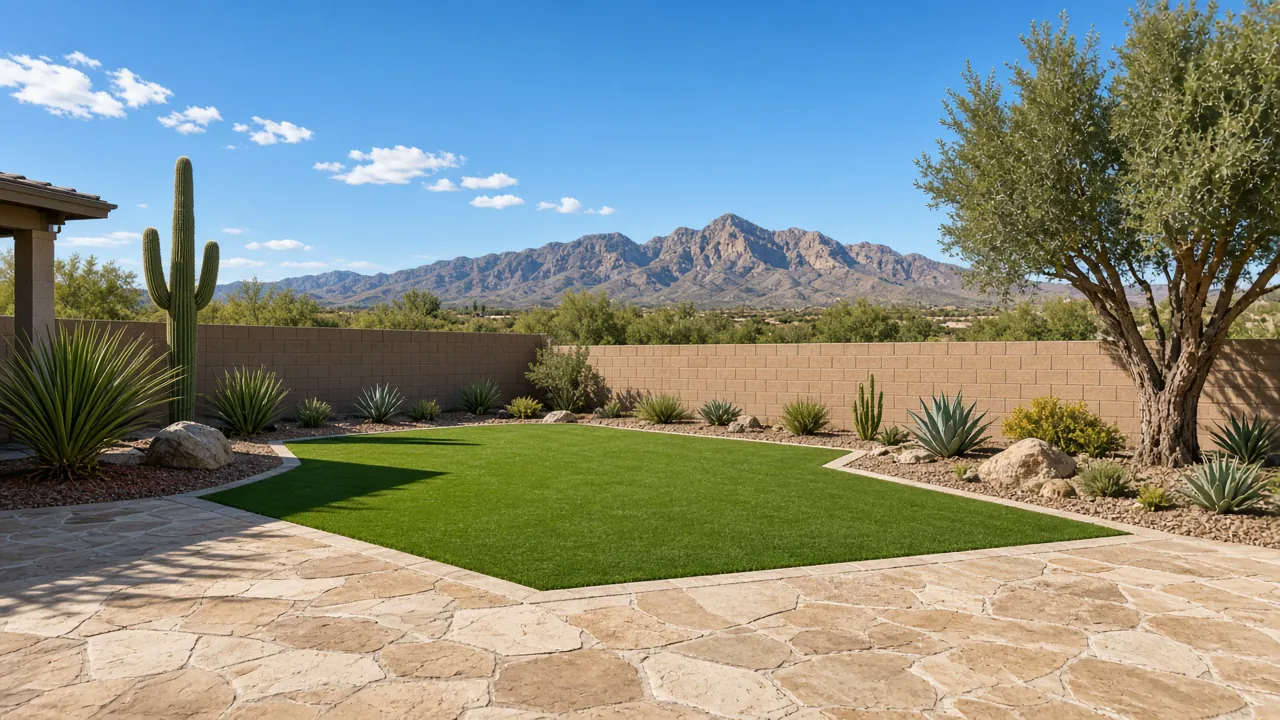
Quick answer: Artificial turf and pavers in Scottsdale can go in the same yard, and the turf portion of about 1,000 square feet is $8,000 to $12,000 at the residential rate on our cost page. Paver pricing varies by material and base and this site does not publish a paver range, so a combined job under $12,000 is not something we can promise from those turf numbers alone.
People ask us for roughly 1,000 square feet of turf plus about 450 square feet of pavers and want to know if the whole thing lands under $12,000. The honest split is below. Turf has a published range. Pavers need an itemized bid. The order of the work matters as much as the total.
The Turf Math We Can Actually Show
On the turf installation cost page, standard residential turf is $8 to $12 per square foot installed. For 1,000 square feet that is $8,000 to $12,000. That figure is the turf area only. It is not a package price for pavers.
The same page also states a wider installed range of $8 to $15 per square foot and says a 1,000 square foot yard at that rate is $8,000 to $15,000. The size bucket for a 1,000 to 2,000 square foot yard is $10,000 to $25,000, because prep and access move the job inside the wider range. Pet turf and pool-surround turf on that page are $10 to $14 per square foot, which would put 1,000 square feet at $10,000 to $14,000 if that is the product you need. Use the residential $8 to $12 line unless the yard is a dog run or a pool edge.
How that turf number compares with keeping grass is in artificial turf versus grass cost. None of those lines include pavers.
Why We Won't Invent the Paver Half
A 450 square foot paver area can be a simple concrete paver on a shallow base or a thick natural stone on a deeper base with a lot of cuts. Those are different jobs. We install turf. We don't publish a paver price and we won't borrow one from another city. Get the pavers as their own line on a bid: demolition, base, the paver itself, edge restraint, joint sand and any steps or curves.
Read the $12,000 question against that gap. The turf at $8 to $12 per square foot already uses $8,000 to $12,000. At the low end you would have $4,000 left for 450 square feet of pavers, the base under them and the edge where the two materials meet. At the high end of the residential turf range the turf alone is the whole $12,000. A combined project under $12,000 is possible only if the turf prices at the bottom of that range and the paver bid is modest. It is not the number to plan on until both bids are itemized. Ask for turf and pavers on separate lines so a low total isn't hiding a thin base.
Do the Hardscape First
The failure we fix most often is a lip. Turf that sits proud of the pavers trips people and dams water. Pavers that sit proud of the turf do the same thing in the other direction. You only get one chance to set those heights, and it is before the turf is stretched.
- One drawing for both surfaces. Mark the turf, the pavers, the border and where water should leave. Finished turf height and finished paver height should meet. Pile height is part of that math, not an afterthought.
- Call 811 before anyone digs. Arizona 811 marks buried lines. A turf crew and a paver crew both need that ticket.
- Set the slope and compact the base. Water should move away from the house, not sit on the seam. The turf side of that base is what we spell out in artificial turf base preparation. A soft base shows up later as wrinkles, puddles and an edge that peels.
- Install pavers and other hardscape first. Bedding, the pavers, the edge restraint and the joint sand go in while the turf area is still open. Polymeric sand stays in the paver joints. It does not belong under the turf.
- Then the turf. Cut it to the restraint, fasten the edge so foot traffic can't peel it and add the infill. A border or a restraint at the joint keeps the turf from creeping onto the pavers and keeps sand from migrating into the turf.
- Check the seam with a hose. Water should cross or drain, not pond on the joint. If it ponds, fix the grade before you call the job done.
Heat, Drainage and the Edge
Pavers and turf both sit in full Scottsdale sun. The stripe where you step from one to the other is not a shaded escape in July. Plan the layout for how you actually use the yard: pavers where you walk in shoes and where a grill or a fire feature needs a hard surface, turf where people sit and play. Give a fire feature a hard border so embers aren't landing on the fibers. Don't dump a downspout or a pool overflow onto the seam.
Drainage is the other half of the edge. Turf needs a base that lets water through and a slope that carries it off. Pavers need the same slope so they aren't a dam. Two different bases that weren't graded together are how you get a permanent puddle on the line between them. Compact in lifts. Don't leave a trench of loose material under the turf just because the paver base stopped six inches away.
One Contractor or Two
One crew that does both can set the elevations in a single pass and own the seam. Two crews can also do good work if they share a height plan and one of them is responsible for the base under both materials. What fails is two bids that each assume the other guy already dug and compacted.
Ask each bid these questions.
- Who excavates and who compacts the base under the turf and under the pavers?
- Who sets the finished height where they meet and what is the allowed lip?
- Who owns the edge restraint and what happens if the turf sits high after the pavers are in?
- Are demolition, haul-off, 811, irrigation moves and drainage called out or assumed?
- If the soil is caliche or the access is a side gate, is that in the number?
A turf bid that says "by others" on the pavers is fine. A turf bid that quietly includes a paver allowance with no material named is not. You want the turf line to match the ranges on our cost page and the paver line to name the product.
How the Two Pieces Compare
| Piece | What we can price from this site | What changes it | When it goes in |
|---|---|---|---|
| About 1,000 sq ft of residential turf | $8 to $12 per sq ft, so $8,000 to $12,000 | Pet or pool turf is $10 to $14 on the same page. Access and a bad base push toward the wider $8 to $15 range | After the pavers and the edge are set |
| The wider 1,000 sq ft yard note | The cost page states $8,000 to $15,000 at $8 to $15 per sq ft | Prep and access. The 1,000 to 2,000 sq ft bucket is $10,000 to $25,000 | Same turf phase |
| About 450 sq ft of pavers | Not published here | Material, base depth, cuts, steps and haul-off | Before the turf |
| The seam | Part of a proper install, not a free extra | Border, restraint and whether the heights were planned together | Set with the pavers, finished with the turf |
Bid Checklist
- Turf square footage and paver square footage measured separately
- Turf line uses a per-square-foot rate you can compare with $8 to $12 residential or the other rates on the cost page
- Paver line names the material and the base. No guessed paver total from us
- One person responsible for finished height at the joint
- Slope away from the house and a hose test before the crew leaves
- 811, demolition and haul-off are written down
- Edge restraint is in somebody's bid
- You are not adding the two numbers in your head and hoping they stay under $12,000
If you want the turf side measured against those ranges, call (480) 435-9404. Bring the paver quote if you already have one. We'll tell you whether the turf number matches the cost page and whether the seam is actually in either bid.
Frequently Asked Questions
Can 1,000 square feet of turf plus 450 of pavers come in under $12,000?
Turf alone is $8,000 to $12,000 at $8 to $12 per square foot on our cost page. Pavers are extra and we don't publish a paver range. Under $12,000 for both is not a number to count on.
Which goes in first, turf or pavers?
Pavers and the edge restraint go in first. Turf is cut and fastened to that edge afterward so the two surfaces meet without a lip.
Do I need one contractor for both?
One crew is simpler. Two crews work if they share the finished height and one of them owns the base. Two bids that each assume the other already dug will leave you a seam.
Will the edge puddle in a monsoon?
It will if the slope stops at the joint. Grade both surfaces so water leaves, compact the base and run a hose before you accept the job.
Where do the turf prices on this page come from?
Only from our turf installation cost page. Residential is $8 to $12 per square foot. We did not add a paver price.