What to Look for in a Dog Run Turf Install in Scottsdale
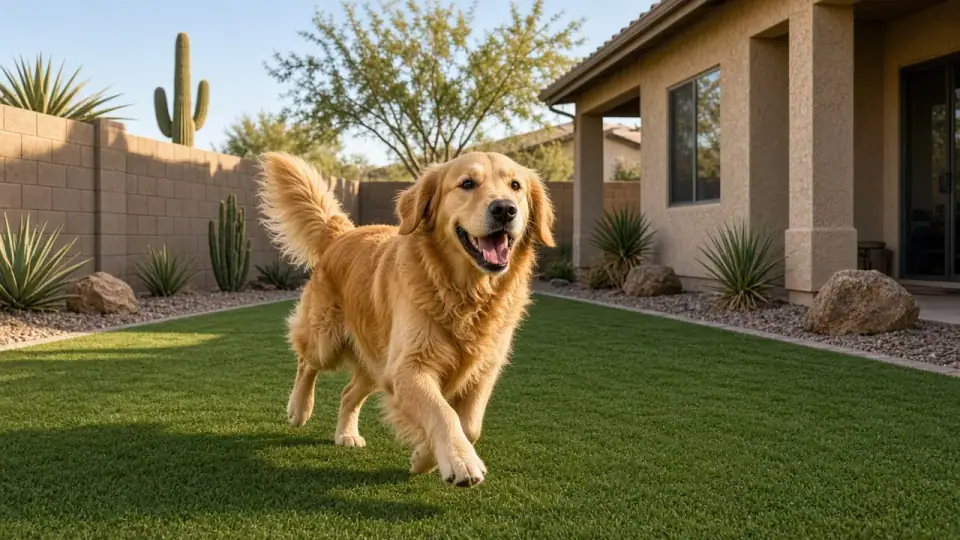
A dog run is not a smaller version of a backyard lawn. It's the strip the dog uses every day, usually along the side yard or a fenced lane. Wear, urine and heat all land in that one place. The turf and the base have to be chosen for that, not for how the lawn looks from the patio.
If you want the whole-yard version, the pet-friendly turf guide covers odor, heat and pile for a regular yard. This one is only the run. The install service is pet turf.
Pile that can be rinsed
Long soft blades look nice and they mat down where a dog walks the same line. They also hold hair and they take longer to dry. A dog run does better with a shorter denser pile that springs back and lets rinse water reach the backing.
Stand on a sample and twist your shoe. If the blades stay folded, that product will stay folded in the run. Part the blades with your hand. You should see a path for water, not a thatch pad that stays damp.
A base that drains in this soil
Scottsdale ground can be tight. A run sitting on compacted dirt or on a sheet that doesn't drain will hold urine. The smell shows up on the first hot afternoon and washing the top doesn't fix a wet base.
Look for a base that lets water through and a slope that moves water out of the run. Water should not sit against the house, a block wall or a bedroom window. Ask where the rinse water goes. "It soaks in" is not an answer if the ground doesn't soak.
If the run is the low side of the yard, it needs a way out. Nice-looking turf over a puddle is the failure people call about later.
Infill you can explain
Infill holds the blades up and gives the turf weight. In a run it also takes the urine. Ask what it is. You want something that drains and that you can rinse. A thick organic fill that stays wet will hold odor. You don't need a brand speech. You need to know whether a hose will flush it or whether the smell has a place to sit.
Skip a heavy thatch layer you can't get water through.
Edges a dog can't lift
Dogs run the fence. They dig a corner. They scratch at the gate. The edge is where a thin install fails.
The turf should be fastened along the fence, the gate and any concrete so a paw can't get under it. A loose edge becomes a flap and then a trip. Seams should not sit in the middle of the path the dog walks. Put the seam where the traffic isn't.
Watch the gate swing. The gate shouldn't drag the pile or catch a corner every time it opens.
Heat, shade and a hose
Turf in full Scottsdale sun gets hot in summer. A run with no shade is a surface a dog may refuse in the middle of the day. Shade from the house, a tree or a sail for part of the day makes the run usable. Don't count on the product name to fix July.
Put a hose bib where you can rinse the run without dragging a hose across gravel. Rinsing is the maintenance. If rinsing is a chore you won't do it and the infill will show it.
What to ask before you install
- What pile is this and why is it short enough for a run?
- What is under the turf and where does water leave?
- What is the infill?
- How are the fence line and the gate fastened?
- Where is the seam?
- Can I rinse this with a hose without washing the base out?
Bring the dog's habits into the conversation. One small dog on a shaded side yard is a different run than two large dogs on a west-facing strip. Request a free quote and tell us the size of the run, how many dogs and which way it faces. We'll spec the base and the pile for that strip instead of handing you a front-yard product.